Dr. Gymbro
←

#cycling performance

1 article
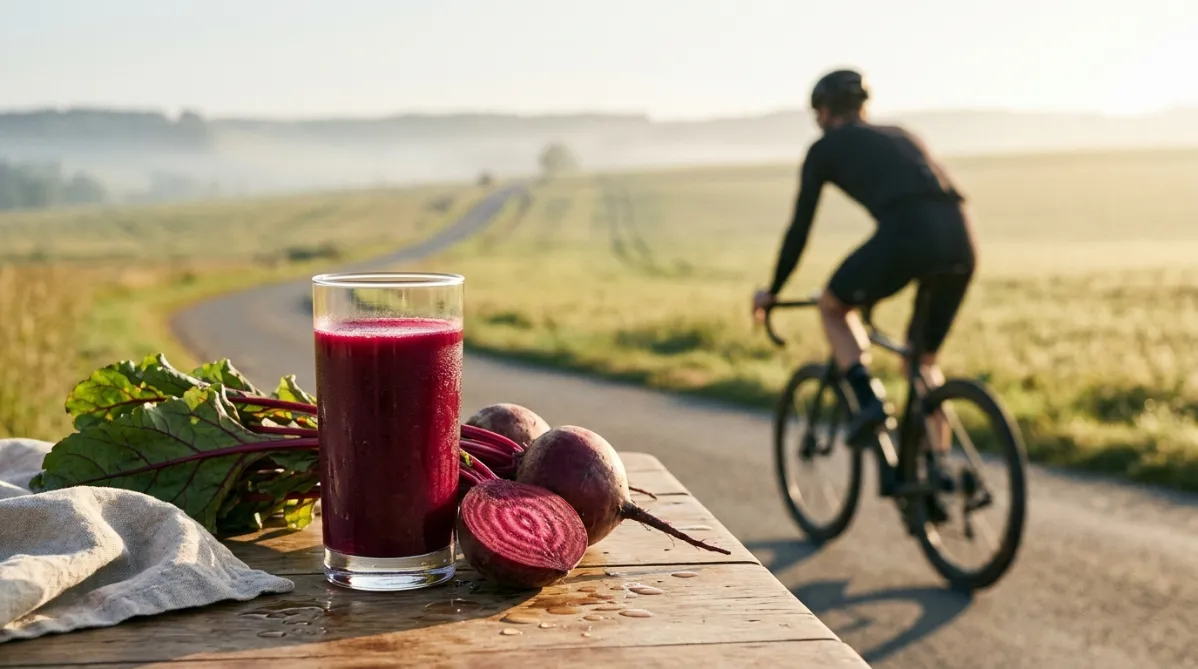
A cyclist in a fitted matte-black kit, shot from a low three-quarter angle, rides a sunlit country road at early morning, slightly out of focus with soft motion blur on the wheels. In the foreground on the left sits a rustic wooden table with a tall glass of deep magenta beetroot juice. Condensation beads on the glass, and the light catches its vivid jewel-toned color. Beside it lie two whole beetroots with their leafy red-veined greens still attached, and one halved beet shows concentric crimson-and-pink rings. A small linen napkin and a scatter of water droplets add an editorial still-life feel.

The background is a gently rolling landscape with golden-green fields and a thin ribbon of asphalt curving toward the horizon. Pale mist hangs low and warm sunlight comes from the right, creating long soft shadows and a golden rim light on the glass and the cyclist's silhouette. The shallow depth of field keeps the juice and beets crisp while the rider stays a dreamy blurred suggestion of speed.

The palette is rich magenta, burgundy, warm cream, sage green, and soft gold, with muted, slightly desaturated tones in the background so the beetroot color stands out. The composition follows the rule of thirds, with the still-life in the lower left third and open negative space in the upper right for the title. The overall look is a clean, modern lifestyle-magazine photograph with natural film-like grain, calm and athletic, and no text, logos, or futuristic elements.
nutrition

Beetroot Juice Before a Time Trial: How 0.5 L Cut 4-km and 16.1-km Cycling Times by Nearly 3%

BY DR. GYMBRO ·

A small but influential 2011 crossover trial tested whether a single drink of beetroot juice could speed up real cycling time trials. Nine competitive male cyclists drank 0.5 L of nitrate-rich juice (about 6.2 mmol nitrate) roughly 2.5 hours before racing. Plasma nitrite more than doubled, mean power rose, and 4-km and 16.1-km times improved by 2.8% and 2.7%. Crucially, oxygen uptake stayed the same, pointing to better cycling economy rather than a bigger aerobic engine. Here is the protocol, the numbers, and the limits of what the data can tell us.

This page is available in